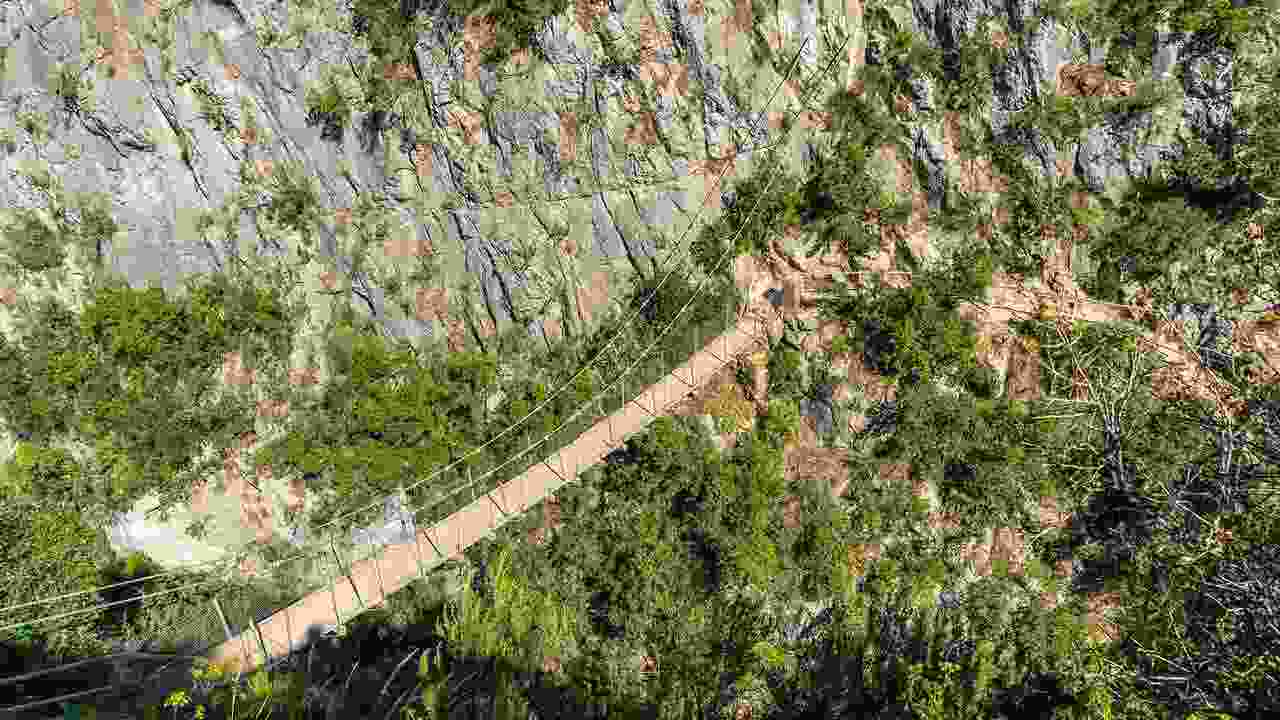
 There’s a certain kind of traveler who sees a shaky, narrow footbridge stretched
between two cliffs and thinks, “Let’s go.” If that’s you—congrats, you’re going
to love this.
Welcome to Mount Trift Bridge
in Switzerland, often called one of the world’s most thrilling—and let’s be
honest, terrifying—footbridges. Suspended nearly 300 feet above a glacier-fed
lake, swaying in the alpine wind, it’s not for the faint of heart. And here’s
the kicker: there’s a two-year waitlist to even step on it during peak season.
So, what makes this footbridge so extreme that people plan their vacation years
in advance? Let’s walk across it—figuratively for now.
There’s a certain kind of traveler who sees a shaky, narrow footbridge stretched
between two cliffs and thinks, “Let’s go.” If that’s you—congrats, you’re going
to love this.
Welcome to Mount Trift Bridge
in Switzerland, often called one of the world’s most thrilling—and let’s be
honest, terrifying—footbridges. Suspended nearly 300 feet above a glacier-fed
lake, swaying in the alpine wind, it’s not for the faint of heart. And here’s
the kicker: there’s a two-year waitlist to even step on it during peak season.
So, what makes this footbridge so extreme that people plan their vacation years
in advance? Let’s walk across it—figuratively for now.
What Is the Trift Bridge?
The Trift Bridge is located in the Swiss Alps, near the town of Gadmen in central
Switzerland. It spans 170 meters (about 560 feet) across a glacial valley and hangs
roughly 100 meters (330 feet) above the ground.
Originally built in 2004 (and then rebuilt stronger in 2009), the bridge was created
to replace access lost due to the retreating Trift Glacier. Since then, it’s become
one of Europe’s wildest walkways—a thin line between two cliffs that makes your
palms sweat just looking at it.
Yeah, it’s that dramatic.
Why the Waitlist?
Simple: demand.
From June to September, this bridge sees a surge in adventure-seekers. But due to
limited cable car capacity, weather unpredictability, and narrow trail access, the
number of visitors per day is capped.
Add in influencers, thrill-seekers, and curious hikers, and the slots book out
fast—sometimes over a year in advance. If you want a prime summer weekend time,
you’d better plan well ahead. Or get lucky with a cancellation.
Getting There Is Half the
Challenge
Reaching the Trift Bridge isn’t just a stroll through the park. First, you take a
small cable car (known as the Triftbahn) from the valley station in Gadmen. It’s a
steep 10-minute ride that climbs over forest and rock.
From there, you hike.
The trail to the bridge is around 90 minutes one-way and involves some steep,
narrow, rocky sections. It’s not overly technical, but it’s definitely not flat.
You’ll earn your view.
And once you round the final corner and see the bridge stretching across the
gorge—it’s jaw-dropping. And slightly panic-inducing.
The Experience: Walking the
Bridge
Let’s not sugarcoat it: walking the Trift Bridge is intense.
- It
sways in the wind. - It
creaks as you step. - It has
just enough bounce to make you
question your life decisions halfway across.
But the views? Unreal.
You’ll see a glacier lake shimmering below, snow-capped peaks surrounding you, and
the remnants of the Trift Glacier off in the distance. It feels like you’re walking
through a postcard—if the postcard was trying to give you vertigo.
Hold onto the cables, breathe steadily, and trust your boots. It’s only scary until
you realize how secure it actually is.
Then it’s just incredible.
Is It Actually Dangerous?
Despite its reputation, the Trift Bridge is incredibly well-engineered and
maintained. Swiss safety standards are no joke.
But the danger people feel is mostly psychological. You’re high up, it’s exposed,
and the drop is dramatic. That said:
- The bridge can close during bad weather. - It’s not recommended for people with a
strong fear of heights. - Children should be supervised closely (and ideally have
experience with similar trails).
But if you’re reasonably fit and not prone to panic on high places? You’ll be
fine—and probably buzzing with adrenaline for hours afterward.
What to Bring
-
Hiking boots with solid grip -
Windbreaker or jacket—it gets
chilly up there, even in summer -
Water +
snacks—no food stalls on the mountain -
Camera or phone—you’ll want to capture
it, guaranteed -
A reservation
confirmation if you're going in peak season
Also: pack your courage. Just saying.
Other Things to Do Nearby
Since you’re already in the Alps, don’t rush back down. The region offers plenty
more to explore:
-
Hike to the Trift Hut if you want
to extend your trek. -
Explore Susten
Pass, one of Switzerland’s most scenic alpine roads. -
Check out nearby glaciers, like the
Steingletscher, for a double dose of jaw-dropping nature. -
Stay overnight in Gadmen or Meiringen
for that cozy mountain vibe.
Best Time to Go
-
June–September is peak season.
Expect crowds, full bookings, and the best weather. -
May and October can be quieter but
riskier with weather and limited access. -
Winter? Forget it. The bridge is closed
due to snow, ice, and the small detail of “certain death.”
Seriously—stick to the warm months.
Crossing the Trift Bridge isn’t just a hike—it’s a challenge. A heart-thumping,
leG-JEGWD9NMSE, camera-clicking adventure that leaves you equal parts thrilled and
humbled.
It’s not just about the danger. It’s about that moment in the middle of the bridge
when you stop, look out over the glacier-carved valley, feel the wind in your face,
and realize—you’re not just walking. You’re
flying, just for a second.