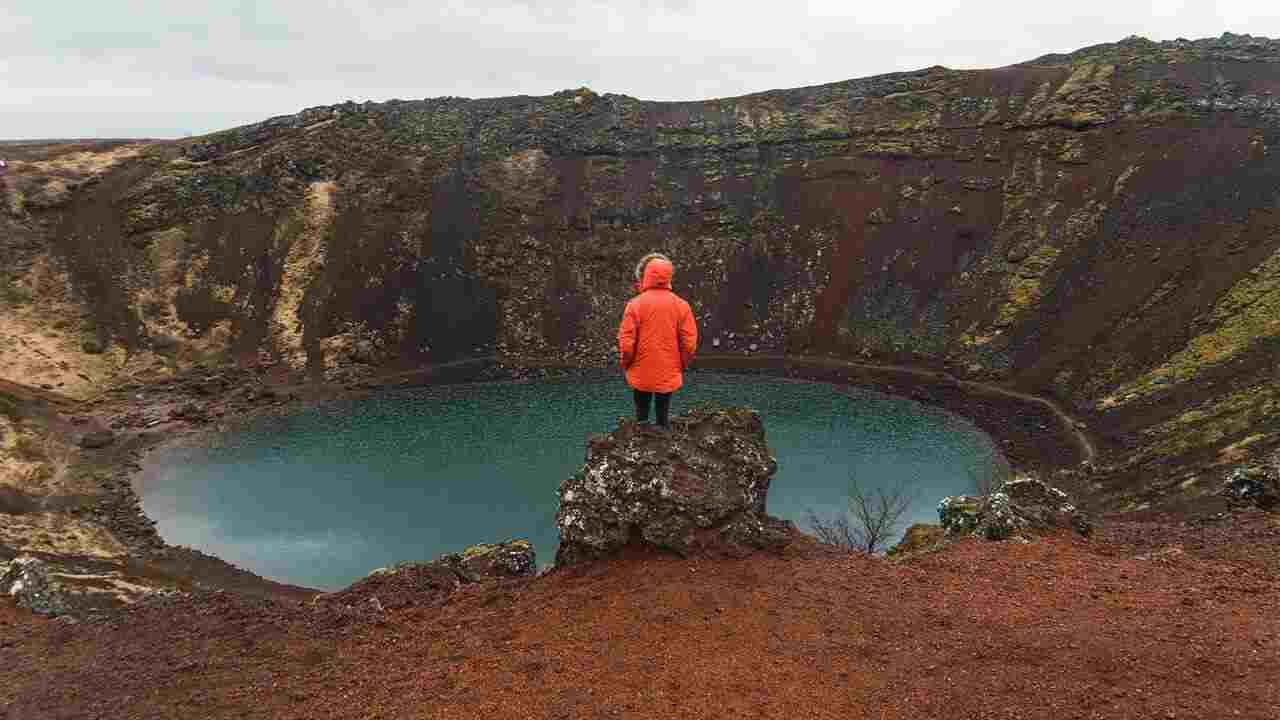
 You know that feeling when you step onto a trail and instantly feel like you’re
in a sci-fi movie? That’s what happens the second your boots touch the rust-red
gravel surrounding Kerið Crater
in southern Iceland. No greenery. No chirping birds. Just wind, rock,
silence—and the surreal sensation that you’ve somehow left Earth behind.
Welcome to one of Iceland’s most underrated, otherworldly adventures: hiking
into a volcanic crater that looks like it was lifted straight out of the Martian
landscape.
You know that feeling when you step onto a trail and instantly feel like you’re
in a sci-fi movie? That’s what happens the second your boots touch the rust-red
gravel surrounding Kerið Crater
in southern Iceland. No greenery. No chirping birds. Just wind, rock,
silence—and the surreal sensation that you’ve somehow left Earth behind.
Welcome to one of Iceland’s most underrated, otherworldly adventures: hiking
into a volcanic crater that looks like it was lifted straight out of the Martian
landscape.
What Exactly Is Kerið?
Kerið (pronounced roughly “Keh-reeth”) is a volcanic crater lake located along
Iceland’s Golden Circle route, not far from popular stops like Gullfoss waterfall
and the Geysir hot spring area. But here’s the twist—it’s not your classic
ash-spewing, lava-belching volcano. It’s the dramatic remains of a collapsed magma
chamber, estimated to be around 3,000 years old.
At about 170 meters (560 feet) wide and 55 meters (180 feet) deep, Kerið isn’t huge.
But what it lacks in size, it more than makes up for in mood. The steep crater walls
glow with rusty red, orange, and ochre tones—thanks to the iron-rich rock—while the
deep teal lake at the bottom feels almost unnaturally still.
Why It Feels Like Mars
It’s not just the color palette (though the Martian reds definitely do the trick).
It’s the raw, eerie quiet. The lack of trees. The wind constantly sweeping across
the top of the crater. The way your voice gets swallowed as you descend into it.
Kerið is often shrouded in mist or low clouds, giving the whole place an extra layer
of mystery. And when the sun hits the rim just right, it casts long shadows across
the bowl, making it feel like you’re exploring an abandoned alien planet.
Bring a friend and pretend you’re astronauts. Or come solo and soak up the spacey
solitude. Either way, it’s going to stick with you.
How to Get There
Kerið is located about an hour’s drive east of Reykjavik, just off Route 35 (one of
the main roads on the Golden Circle). It’s super easy to reach by car, and many
guided tours include it as a stop.
There’s a small entrance fee (about 450 ISK, or $3 USD) to help maintain the site,
and there’s a gravel parking lot with toilets and information boards.
Pro tip: Visit early in the morning or late afternoon to avoid the tour bus crowds.
It’s 100x better when it’s quiet.
The Hike: Short, Simple,
Stunning
Let’s be honest—this isn’t some grueling, multi-day trek. You don’t need ice axes or
survival skills. The hike around Kerið’s rim takes maybe 15–20 minutes, depending on
how often you stop to snap photos or stare in awe (which will be often).
The trail is well-marked and relatively flat, but there are some steep edges and
loose gravel, so wear decent shoes and watch your step. For a more immersive
experience, take the short path down into the crater to the edge of the lake. You’ll
get a whole new perspective from down there.
It’s not physically demanding. It’s mentally and visually absorbing.
What to Expect (and What Not
To)
-
Expect color. No joke—this place
has some of the richest earth tones you’ll see in Iceland. -
Don’t expect a crowd. Compared to spots
like Skógafoss or Thingvellir, Kerið feels refreshingly quiet. -
Expect wind. Bring layers and hold onto
your hat. That rim can be breezy. -
Don’t
expect tons of facilities. It’s minimal here—just parking, toilets, and
the trail. No souvenir shops, no cafés. -
Expect wonder. Especially if you’re the
kind of traveler who likes moody, dramatic vibes over flashy tourist spots.
Best Time to Go
Kerið is accessible year-round, but it wears different faces depending on the
season:
-
Summer (June–August): Warmest
weather, longest days, most visitors. -
Fall
(September–October): Gorgeous golden light and fiery autumn tones. -
Winter (November–March): The lake
might freeze over, and the crater may be dusted with snow. It’s hauntingly
beautiful—but slippery. -
Spring
(April–May): Quiet, with hints of green returning to the landscape.
Personally, fall is the sweet spot. Fewer crowds, rich colors, and crisp air. Just
check road conditions before you go—weather changes fast in Iceland.
What to Bring
You won’t need a full hiking kit, but a few essentials make the experience better:
-
Sturdy shoes with grip (the
descent can be slippery) -
A windproof
jacket—the crater rim is exposed -
Water—there’s no fountain or shop
nearby -
Camera or phone—the light
plays beautifully on the rocks -
A sense of
wonder (yeah, cheesy—but true)
Optional: A small snack or thermos of tea to sip while sitting by the lake. You’ll
feel like a very cozy astronaut.
Fun Fact: Kerið and Iceland’s
Musical Connection
If you're into Icelandic music, you might love this tidbit: Kerið has been used as a
concert venue! Its natural acoustics and amphitheater-like shape make it an
unforgettable spot for live music. Imagine listening to Sigur Rós while seated on
Martian rock under the northern lights.
Yeah, that happened.
Nearby Bonus Adventures
Since you're already here, why not make a day of it? Other great stops nearby
include:
-
Geysir Geothermal Area – Erupting
hot springs and bubbling earth. -
Gullfoss
Waterfall – One of Iceland’s most powerful and iconic falls. -
Secret Lagoon – A quieter alternative
to the Blue Lagoon for soaking.
These are all within a short drive of Kerið, making for an epic mini road trip full
of contrast—fire, ice, and outer space vibes.
Kerið Crater isn’t flashy. It’s not packed with waterfalls or sprawling glaciers.
But it doesn’t need to be. It’s quietly, confidently epic.
It gives you that rare “I can’t believe this place exists” feeling—without crowds,
long lines, or noise. Just you, red rock, a still lake, and that whisper in your
brain saying: “Are we even still on Earth?”